A High-Impact study in Signal Transduction and Targeted Therapy (IF: 52.7) used GenePharma modified siRNAs as core tools, deciphering how YTHDF1 promotes the stemness of colorectal cancer (CRC) initiation and chemotherapy resistance via regulating NOTCH1 translation. The Chinese University of Hong Kong team inhibited NOTCH1-induced cancer stem cell properties by targeting m⁶A reader YTHDF1, providing a new strategy to overcome chemoresistance.

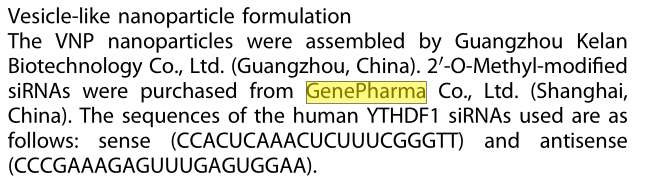
This study focuses on colorectal cancer stem cells (CSCs), a key tumor therapy target. The team found m⁶A reader YTHDF1 is highly expressed in colorectal CSCs; it binds to the 3'UTR of m⁶A-modified NOTCH1 mRNA to enhance translation, promoting CSC stemness, tumorigenesis, and chemoresistance. For validating this mechanism, GenePharma’s 2’-O-Methyl modified siRNAs silenced NOTCH1 specifically, reversing YTHDF1-overexpression phenotypes (enhanced self-renewal, increased spheroids) and providing direct evidence for the YTHDF1-NOTCH1 axis regulating colorectal CSC stemness.
Trusted By Leading Research: GenePharma Modified siRNA
Conventional siRNAs have limitations in gene silencing: poor stability, nuclease susceptibility, high immunogenicity, and weak targeting. GenePharma’s 2’-O-Methyl modified siRNAs resolve these via precise chemical modification:
i. Reduced Immunogenicity & Safety: Mitigates siRNA-induced cytokines, avoiding non-specific immune interference; suitable for high-dose and long-term preclinical toxicity studies.
ii. Enhanced Nuclease Resistance & Durability: Boosts serum stability, sustains gene silencing, and reduces administration frequency for simpler experiments.
iii. Improved Target Affinity & Silencing Efficacy: Maintains stability/safety without affecting RISC activation, ensuring accurate target binding and efficient silencing.

From Optional to Indispensable: The Versatile Applications of Modified siRNA
Beyond 2’-O-Methyl modification, GenePharma offers tailored modified siRNAs for research and pharmaceutical development.
i. In Vivo Experiments: 2’-F/PS combined modification enhances serum stability and in vivo half-life, overcoming conventional siRNA degradation for durable silencing and reliable data.
ii. Hepatocyte-Targeted Research: GalNAc-modified siRNAs enable precise liver targeting, advancing NASH and hypercholesterolemia drug development.
iii. Hard-to-Transfect Cells: Cholesterol-conjugated siRNAs improve uptake in neurons/primary cells without liposomal reagents, facilitating related research.
iv. Mechanistic Studies: Fluorescently labeled siRNAs enable real-time tracking, aiding mechanism analysis and exploration of the YTHDF1-NOTCH1 axis.
From basic gene function verification to preclinical validation, modified siRNAs are indispensable for breaking research bottlenecks.
GenePharma: A Quality Product. A Trusted Partner
Modified siRNAs are indispensable for breaking research bottlenecks. Their recognition by top teams reflects GenePharma’s 20-years siRNA expertise as Asia’s largest oligonucleotide manufacturer:
i. Strong Technical Capabilities: Masters core siRNA synthesis technologies, with 4 platforms, 71 patents (end-2025) and 80,000+ SCI citations, leading in technical barriers.
ii. Full Industrial Chain: Vertically integrated from RNA monomers to drugs; 1,500 m2 pilot plant enables seamless R&D-industrialization. It aided 10+ drugs (some IND, BIC/FIC), with upcoming MNC BD.
iii. Authoritative Quality: ISO9001/ISO13485 certified, with QC reports (HPLC, MS) exceeding industry standards.
iv. Comprehensive Services: One-stop consulting and sound IP protection safeguard customer innovation.
v. Achievement Transformation: 20+ years of collaboration; high-level papers (e.g., Science Translational Medicine, IF: 14.6) and patented technologies support drug translation.
vi.
GenePharma’s integrated strength makes it a trusted partner for global researchers and pharmaceutical companies in siRNA research and drug development.

For more information about the paper, please contact us bd@genepharma.com
Or you can visit: https://doi.org/10.1038/s41392-025-02507-1